This has already been achieved


Overview of Implemented Measures
Promotion of alluvial forests
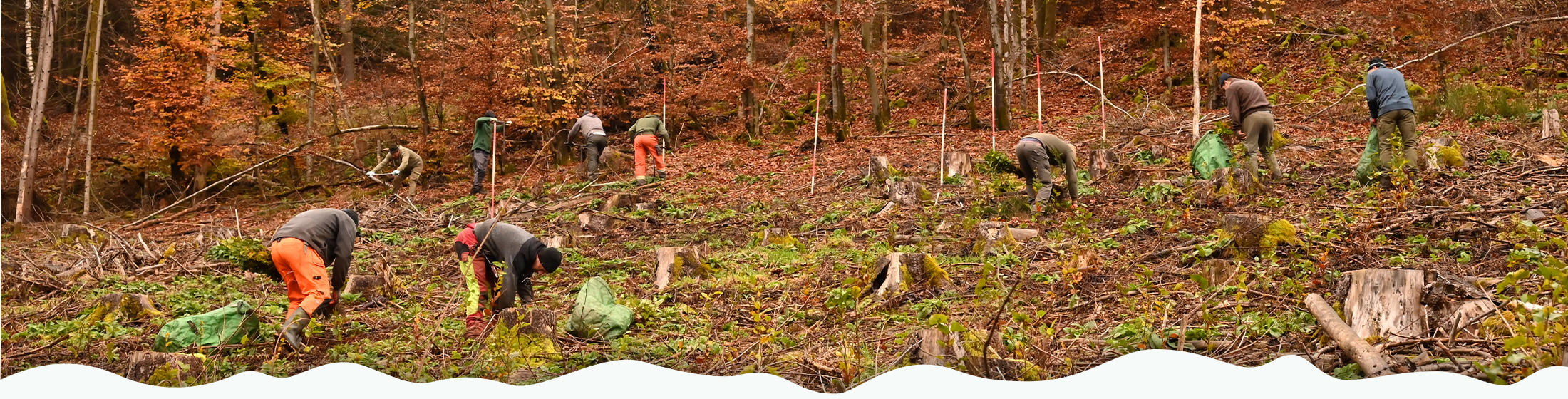
Approximately 85,500 black alders (Alnus glutinosa) were planted to promote alluvial forests dominated by black alder, ash, and softwood trees. As already indicated by the name of this habitat type, common ash (Fraxinus excelsior) is also one of its characteristic species. However, common ash is currently severely affected by the ash dieback fungus (pathogen: Chalara fraxinea). To minimize the risk of infection of the remaining healthy ash stands within the Special Protection Area, the planting of Fraxinus excelsior was deliberately omitted in the LIFE project.
Alluvial forests (91E0*) play a crucial role for various species, particularly woodpeckers such as the middle spotted woodpecker (Dendrocoptes medius), the grey-headed woodpecker (Picus canus), and the black woodpecker (Dryocopus martius). These species benefit in particular from the abundant availability of softwood.
In addition, these habitats are also of great importance for the violet copper (Lycaena helle). It uses the structurally diverse floodplain forests, with their moist and cool microclimate, as corridors between nutrient-rich grassland areas. Promoting this habitat therefore contributes to the connectivity and conservation of this endangered species.

Area to be planted

Black alder planting stock
Promotion of oak forests
Within just two years, 49,500 oaks have already been planted! Pedunculate oaks (Quercus robur) were used on wetter sites, while sessile oaks (Quercus petraea) were planted on drier soils. To protect the young plants, they were either planted in fenced areas or equipped with browsing protection, as their buds are among the favorite foods of roe deer and red deer.
Oak forests have great cultural and historical significance in the Siegerland region. In the traditional Hauberg forest management system, oaks were primarily planted. Their bark was used to produce tanning bark, while the wood was used both for charcoal production and as firewood.
However, not only humans benefited from oak forests. The middle spotted woodpecker (Dendrocoptes medius) prefers deciduous forests with a high proportion of rough-barked oaks, which provide both food and sufficient deadwood for nesting cavities. The red kite (Milvus milvus) also frequently chooses old oaks as nesting sites.

Oak forests

Young pedunculate oaks in winter with browsing protection

Young pedunculate oaks in autumn with browsing protection
Promotion of Luzulu-Fagetum beech forests
With 46,500 trees planted, the European beech (Fagus sylvatica) achieved an impressive third place! The young shoots were carefully protected, either with browsing guards or by using a repellent that makes them unattractive to roe deer and red deer.
As the dominant tree species of Luzulu-Fagetum beech forests and the most common native deciduous tree in Germany, the European beech is a vital part of our landscape. Its remarkable adaptability allows it to thrive on a wide variety of soils and across nearly all climate zones in Germany. This flexibility may become increasingly important in the future, as expected climate changes pose significant challenges to our forests.
Our target habitat, the Luzulu-Fagetum beech forest, provides a protective environment for numerous bird species, endangered bats, a remarkable diversity of beetles, and butterflies that are bound to the forest. The oldest trees, proudly 120–130 years old, are skillfully excavated into cavities by the black woodpecker (Dryocopus martius). These valuable homes often become occupied by other forest inhabitants in subsequent years. The red kite (Milvus milvus) also finds ideal nesting sites in the beech trees. The grey-headed woodpecker (Picus canus), in contrast, especially values the beech forest for its abundance in habitat trees and deadwood.

Planting of European beech
Demonstration Areas for Browsing and Rub Protection in Deciduous Tree Plantings and for Deciduous Tree Planting Concepts
To promote sustainable reforestation and ensure a nature-friendly forest restructuring, two demonstration areas were established. These areas showcase different planting concepts and protection measures against browsing damage.
For the plantings, various methods were applied:
- Row plantings with tree species such as black alder, small-leaved lime, and sycamore maple.
- Group or clump plantings with species like European beech, pedunculate oak & hornbeam, and pedunculate oak & small-leaved lime.
The demonstration areas serve not only as practical examples but also provide forest owners with the opportunity to explore innovative approaches to reforestation. Continuous exchange and expert advice are key components of the project.
1.- Demonstration area for deciduous tree planting
This area implements several planting concepts: row planting, group or clump planting, pre-regeneration under conifer stands, and natural forest development. An information board explains the characteristics of the base sites, the specific implementations, and the advantages and disadvantages of each approach.
2.-Demonstration area for browsing protection
Here, nine different types of browsing and rub protection are presented, including innovative methods to protect young trees and ensure their healthy growth. An accompanying information board provides a clear table with the following details: browsing protection type, material, price, effective height, and characteristics (assembly/disassembly and biodegradability).

Information Board: Concepts for planting deciduous trees

Information Board: Browsing and rub protection of deciduous tree plantings
Felling of hybrid poplars and Planting of Deciduous Forest
In 2023, as part of our land acquisition program, we were able to purchase a 1.5-hectare area. This land now belongs to the state of North Rhine-Westphalia and is under long-term protection. In the following year, 2024, the area, originally planted with hybrid poplars, was transformed into a species-rich deciduous forest.
Our goal was to replace the non-native hybrid poplars with native tree species such as small-leaved lime, pedunculate oak, sycamore maple, and black alder. Only trees that contained woodpecker cavities were deliberately retained, as they play an important role as habitat for these bird species.
A portion of the felled tree trunks was intentionally left in the forest. These deadwood habitats are vital, as they provide shelter for numerous beetle species. These beetles, in turn, are an important food source for our target woodpecker species, contributing to the forest’s natural cycle.
During the work, we discovered a cattle skull, which now serves as a symbolic totem, a guardian representing the protection and future of this forest.

Cattle skull – our symbolic totem.