Optimization of species-rich grasslands (C5)
On a total area of 46 ha, various grassland habitat types (6230 *, 6410, 6510, 6520) are to be converted into a favorable conservation status to promote insects and ground nesting birds. On a further 40 ha, insect-rich grassland is to be implemented in the long term through alternative mowing techniques. These measures are in direct coherence with all grassland areas in the project area (320 ha), which are to be permanently preserved through land acquisition, an adapted management concept and contract nature conservation as an after-LIFE measure. Together with Action C4, 355 ha of species-rich grassland can thus be created, optimized and permanently secured.
| Target area: | 86 ha |
|---|---|
| Measures: | Unfelting of Nardus grasslands, de-bushing, the introduction of sectoral mowing, mown material transfer, supplementary seeding or the removal of nuisance plants, e.g. invasive species |
| Target species: | Whinchat, Violet Copper, Marsh Fritillary |
Progress of measures:
Since the first project year (2022), an annual action day to control the toxic ragwort in the FFH area "Buchheller-Quellgebiet" has been held. As a result, safe hay use on an area of about 50 hectares has been ensured. Since May 2024, efforts have also been made to combat the invasive lupine within the project area. This invasive plant species could lead to the loss of valuable conservation areas if it spreads further and should therefore be suppressed as early as possible.
In the open land areas of the FFH area "Rübgarten," sectoral mowing was resumed in 2023. This measure aims to revitalize the overgrown fallows and make them more attractive for butterflies and other species. In spring 2023, bush clearance measures began in the FFH areas "Hickengrund/Wetterbachtal" and "Buchheller-Quellgebiet" to improve habitats for the Marsh Fritillary butterfly by planting specific caterpillar food plants.
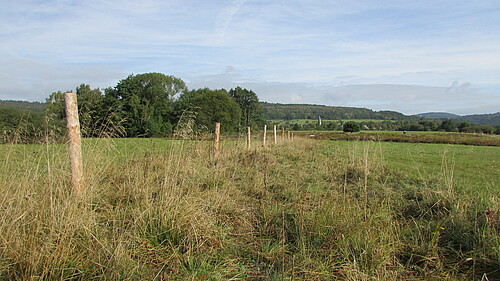
In 2024, approximately 4 hectares of rotational fallows were established in the extensive grassland, which are now to be alternately designated for grazing or mowing each year. This approach aims to provide a safe retreat for insects and ground-nesting birds.