Re-introduction of the Marsh Fritillary (C6)
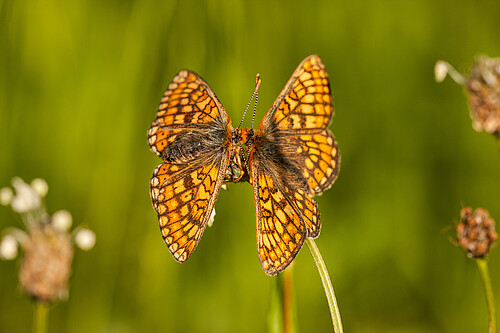
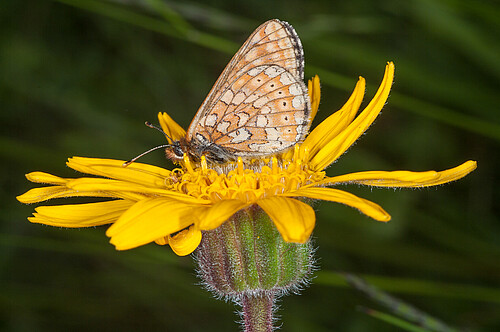
Since 2014, the Marsh Fritillary could no longer be found in the project area and is therefore currently considered lost in the entire district of Siegen-Wittgenstein. Within the project, the species is therefore to be re-introduced. The goal is to establish a self-sustaining population in the habitats that have been improved beforehand. The IUCN criteria for re-introduction will be taken into account. Appropriate maintenance management is to be implemented and maintained within the framework of After-LIFE. The species will be reintroduced by means of propagation breeding. Animals for the propagation breeding will be taken from neighboring populations in Rhineland-Palatinate.
Progress of measures:
At the end of September 2022 and 2023, seed collections of devil's-bit scabious (Succisa pratensis) were carried out. This plant is essential as a food source for the larvae of the Marsh Fritillary butterfly (Euphydryas aurinia) and, after propagation, is introduced into the appropriate habitats of this butterfly species. In 2023, 1200 plants were already planted.
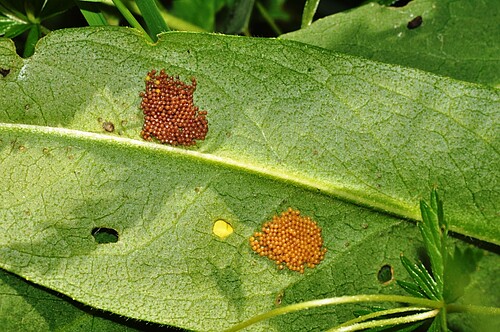
In collaboration with our partner, the LIFE project "helle Eifeltäler" (www.life-helle-eifeltaeler.eu), with the support of the SGD Nord and the LIFE project "Rhöner Bergwiesen," the propagation of the Marsh Fritillary butterfly has begun. Unfortunately, this was still unsuccessful in 2023. However, by June 2024, the first butterflies were already flying in our breeding tents, establishing our breeding population after egg laying. In 2024, additional individuals, for example from the Hessian Rhön, will be integrated into our breeding population to increase genetic diversity. The release of the first animals can only begin in 2025 at the earliest.